

Reviewed by a Licensed Master Electrician with over 20 years of residential and commercial electrical experience. This article follows current National Electrical Code (NEC) standards and is written to help homeowners make safe, informed decisions about their home electrical systems.
Your home runs on electricity. Every light you flip on, every appliance you plug in, and every device you charge go through one central place: your electrical panel. Most homeowners never think about it. It sits quietly in a closet or basement, doing its job without any attention. But when it starts struggling, the whole house feels it.
Electrical panel upgrades are one of the most important home safety decisions you can make. If your home is older than 25 years, if your breakers keep tripping, or if you are adding new appliances, your panel may already be telling you it needs help. This guide breaks down everything you need to know in plain, simple language so you can make the right decision for your home and your family.
What Is an Electrical Panel and What Does It Do?
Your electrical panel is the main distribution point for all electricity coming into your home from the utility company. It splits that electricity into separate circuits and sends each circuit to a different part of your house. Every bedroom, kitchen, bathroom, and major appliance has its own circuit.
Inside the panel, you have circuit breakers. These are small switches that automatically shut off when a circuit gets too much power flowing through it. That is a safety feature. It stops wires from overheating and causing a fire. When your panel is old, oversized for your current needs, or simply worn out, those breakers start having trouble keeping up.
What Is an Electrical Panel Upgrade?
An electrical panel upgrade means replacing your existing breaker box with a new, more capable one. It can mean going from fewer circuits to more, or increasing the total amperage your home can safely use. Most commonly, it means upgrading the electrical panel to 200 amps from an older 60-amp or 100-amp system.
An electrical panel replacement is slightly different. That means swapping out a damaged or failed panel for a new one of the same size. But in most cases, when professionals replace a panel, they recommend upgrading at the same time. The labor cost is similar and the long-term benefits are significant.
Key Parts Inside Your Electrical Panel
Understanding what is inside the panel helps you follow what happens during an upgrade. The main components include:
The main circuit breaker controls all power flowing into the panel. Bus bars are the metal strips that carry electricity from the main breaker to the individual circuit breakers. Individual circuit breakers protect each separate circuit in your home. The neutral bar and ground bar safely manage the return path of electricity and protect against shock.
When any of these parts age, corrode, or become overloaded, the whole system becomes less safe.
Clear Signs You Need Electrical Panel Upgrades
Your home will show you warning signs before things get dangerous. The problem is that most people ignore them or assume they are normal. They are not normal. They are your electrical system, asking for help.
Your Breakers Keep Tripping Over and Over
A circuit breaker that trips once in a while is doing its job. A breaker that trips every time you run the microwave and toaster at the same time is telling you the circuit is overloaded. If you are constantly walking to the panel to reset breakers, your panel does not have enough capacity for your home’s current electrical load.
Lights Flicker or Dim When Appliances Start Up
This is one of the most common signs of a struggling panel. When a large appliance like an air conditioner or washing machine kicks on, it draws a big burst of power. If your lights dim or flicker in that moment, the panel is having trouble delivering stable voltage across all circuits at the same time.
You Smell Something Burning Near the Panel
A burning smell near your breaker box is a serious emergency. It usually means wires or connections inside the panel are overheating. This is a direct fire hazard. Do not ignore it. Turn off the main breaker and call a licensed electrician immediately.
The Panel Feels Warm, or You Hear Buzzing
An electrical panel should never feel warm to the touch and should never make buzzing, crackling, or humming sounds. These are signs of loose connections, faulty breakers, or internal arcing inside the panel. Arcing happens when electricity jumps across a gap, and it is one of the leading causes of electrical fires in homes.
You See Scorch Marks or Discoloration
Visible burn marks or discoloration around breakers, outlets, or the panel door are signs that overheating has already occurred. This is not a cosmetic problem. It shows that heat damage has happened inside the electrical system.
Your Home Still Has a Fuse Box
Homes built before the 1970s often still have fuse-based panels instead of modern circuit breaker panels. Fuses work, but they are outdated; they cannot handle modern electrical loads, and they are incompatible with newer safety technology like GFCI and AFCI protection.
Should I Upgrade My Electrical Panel?
Ask yourself these questions. Is your home more than 25 years old? Do you have a fuse box instead of breakers? Do your breakers trip regularly? Are you planning to add an EV charger, hot tub, new HVAC system, or solar panels? Are you finishing a basement or adding a room? If you answered yes to any of these, the answer is very likely yes; you should have your panel evaluated by a licensed electrician.
Fuse Box vs Circuit Breaker Panel
Many older homes have never had their fuse boxes replaced. Here is a simple side-by-side breakdown so you can understand the difference.
A fuse box uses small metal fuses that physically melt and break when a circuit is overloaded. Once they blow, you have to replace them. They cannot be reset. Most fuse boxes top out at 60 to 100 amps of total service, which is not nearly enough for today’s homes. They are also incompatible with GFCI and AFCI outlets, which are required by modern building codes in kitchens, bathrooms, garages, and outdoors.
A modern circuit breaker panel uses switches that trip when overloaded. You simply flip them back to reset. Modern panels support 100 to 400 amps or more. They fully support GFCI and AFCI breakers, which detect dangerous electrical conditions and cut power within fractions of a second. They meet current National Electrical Code requirements and are what insurance companies and home inspectors expect to see.
If your home has a fuse box, upgrading to a modern breaker panel is not optional. It is a safety priority.
How to Upgrade an Electrical Panel Step by Step
Understanding the process makes the whole thing less stressful. Here is exactly what happens when a licensed electrician upgrades your panel.
Step 1: Electrical Load Assessment
Before anything is ordered or installed, the electrician does a full load calculation. This means adding up all the electrical demands in your home: existing appliances, HVAC systems, lighting, and any planned additions. This tells them exactly what size panel you need. Skipping this step is one of the biggest mistakes homeowners make when they hire unqualified people for the job.
Step 2: Permit Application
A permit is required for electrical panel work in virtually every city, county, and state in the United States. Your electrician applies for it with your local building department. Do I need a permit to upgrade my electrical panel? Yes. Always. Without a permit, the work cannot be inspected. Without inspection, your homeowner’s insurance may not cover damage related to the unpermitted work, and the work may need to be redone when you try to sell your home.
Step 3: Utility Company Coordination
Your utility company needs to disconnect power from the service entrance before the electrician can safely work on the panel. This is arranged in advance. On the day of work, the utility pulls the meter, and the electrician has safe access to complete the installation.
Step 4 – Old Panel Removal
The old breaker box or fuse box is carefully disconnected and removed. All existing circuit wiring is labeled and organized so it can be properly connected to the new panel.
Step 5: New Panel Installation
The new panel is mounted, and the bus bars, main breaker, and individual circuit breakers are installed. Each circuit is connected and properly labeled. If any existing wires are too short, the electrician installs proper junction boxes to extend them safely according to code. If knob and tube wiring or aluminum wiring is found in older homes, the electrician will discuss next steps because these require special handling before connecting to a modern panel.
Step 6: Grounding and Bonding Update
Modern electrical safety standards require proper grounding electrode conductors, ground rods, and bonding connections. These are checked, updated, and verified during the upgrade process.
Step 7: Inspection and Power Restoration
A city or county inspector comes to verify that everything was done to code. Once approved, the utility restores power, and the job is complete. Most panel upgrades are finished in one day, typically six to ten hours.
Upgrade Electrical Panel to 200 Amps: Do You Actually Need It?
This is the most common question electricians hear. Most homes built before 1990 were wired for 100-amp service. That was enough at the time. Today, the average home uses two to three times more electricity than homes did 30 years ago.
Upgrading the electrical panel to 200 amps is now considered the standard for any home planning to add modern appliances. Here is why 200-amp service makes sense for most homeowners today.
A 200-amp panel can support a Level 2 EV charger, which requires its own dedicated 40 to 50-amp circuit. It supports modern HVAC systems, including heat pumps and central air. It has enough slots to add circuits for a home office, home gym, finished basement, or accessory dwelling unit. It gives you capacity for whole-home surge protection and battery backup storage if you ever add solar panels.
How to Upgrade an Electrical Panel to 200 Amps
The process for how to upgrade an electrical panel to 200 amps specifically involves a few additional steps beyond a standard panel swap. The electrician first confirms that your service entrance cable, which is the wire coming from the utility to your home, can handle a 200-amp capacity. If it cannot, that wire may need upgrading, too, which involves additional coordination with the utility company. A new 200-amp main disconnect is installed, a panel with adequate breaker slots is selected and mounted, and all existing and new circuits are connected and organized. The grounding system is upgraded to match the new service size. Finally, the work passes inspection before power is restored.
Cost to Upgrade Electrical Panel to 100 Amps: Is It Right for Your Home?
Not every home needs to jump straight to 200 amps. For smaller homes under 1,200 square feet with modest electrical needs, the cost to upgrade the electrical panel to 100 amps can be a practical and sufficient step forward.
A 100-amp upgrade is a smart choice if you are moving from a 60-amp fuse box and your home does not have high-demand appliances. It meets modern code requirements, supports GFCI and AFCI protection, and gives you a safe, reliable system. However, if there is any possibility you will add an EV charger, a hot tub, central air conditioning, or any major new appliance in the next five to ten years, going directly to 200 amps is almost always the smarter long-term decision. You will avoid paying for a second upgrade later.
Benefits of Electrical Panel Upgrades
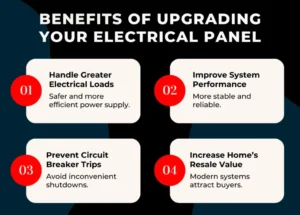
Electrical panel upgrades are not just about fixing problems. They are a forward-looking investment that pays off in several meaningful ways.
Dramatically Improved Home Safety
The most important benefit is safety. Old panels are linked to thousands of residential electrical fires every year. A modern panel with AFCI breakers detects dangerous arcing and cuts power before it starts a fire. GFCI breakers protect against deadly shock in wet areas like kitchens, bathrooms, and garages. These are not optional extras. They are life-saving features that old panels simply cannot provide.
Support for Modern Appliances and Technology
Induction ranges, heat pump water heaters, smart home systems, EV chargers, whole-home generators, and battery storage systems all need reliable, dedicated circuits. A new panel gives you the slots and the capacity to add these without overloading the system or compromising safety.
Higher Home Resale Value
A home with an updated electrical service panel is more appealing to buyers. Real estate inspectors routinely flag outdated panels. When an old panel shows up in an inspection report, buyers ask for a price reduction or walk away. An upgraded panel removes that obstacle and tells buyers the home has been maintained responsibly. Homes with modern electrical systems often sell faster and at stronger prices.
Potential Insurance Savings
Some insurance companies charge higher premiums for homes with old fuse boxes or outdated panels because of the higher fire risk. After an upgrade, you may qualify for a lower rate. Always contact your insurance provider after completing an electrical panel replacement to ask about any available discounts.
Electrical Panel Upgrade Tax Credit
Under the federal Energy Efficient Home Improvement Credit, homeowners who make qualifying electrical panel upgrades as part of broader energy efficiency improvements may be eligible for a tax credit of up to $600 as part of a $3,200 annual cap. This credit is available through 2032 for improvements made after January 1, 2023. Always consult a qualified tax professional to confirm your eligibility based on your specific situation and local rules.
Electrical Panel Upgrade Rebate Programs
Beyond the federal tax credit, many utility companies across the country offer direct rebates when you upgrade your panel as part of an energy efficiency initiative. These electrical panel upgrade rebate programs vary significantly by region and provider. Contact your local electric utility and check your state’s energy office website to find out what is available where you live.
Free Electrical Panel Upgrade Programs
Some state governments, nonprofit organizations, and utility companies offer free electrical panel upgrade assistance for qualifying homeowners, particularly lower-income households. These programs are especially common in states with aggressive clean energy goals. Check with your utility company, your state energy office, and programs like the federal Weatherization Assistance Program to see if you qualify for any free or deeply discounted panel upgrade assistance in your area.
Residential Electrical Panel Upgrade Trends in 2025
The electrical needs of American homes are changing faster than at any point in history. In 2025, residential electrical panel upgrade trends are being driven by three major forces: home electrification, EV adoption, and clean energy.
More homeowners are switching from gas appliances to electric alternatives. Heat pump water heaters, induction ranges, and electric dryers are all moving into homes that were never designed to handle that kind of load. At the same time, EV charger installations are growing rapidly, with Level 2 chargers needing dedicated 240-volt circuits. Solar panel and home battery installations require panels with enough bus bar capacity and breaker space to support grid-tied systems.
The result is that 200-amp panels are now considered the baseline for new construction, and many electricians are installing 400-amp panels in larger homes or homes planning full electrification. If you are thinking about any of these upgrades in the next few years, your panel assessment should happen first.
Best Time to Upgrade Electrical Panel Safely
The best time to upgrade the electrical panel is before a problem forces your hand. Reactive upgrades, done after a breaker failure, a small fire, or a failed inspection, are always more stressful and often more expensive than planned ones.
The ideal time to schedule an electrical panel upgrade is when you are planning a renovation, when you are adding a major new appliance or system, when your home is more than 25 to 30 years old and has never had the panel replaced, or when you are getting ready to list your home for sale.
Scheduling during spring or fall tends to be easier because electricians are less backed up than during peak summer months. Whatever time you choose, make sure you hire a licensed, insured electrician and that all permits are pulled before work begins. Never let anyone do electrical panel work without a permit.
Commercial Electrical Panel Upgrades
Homes are not the only buildings that need panel upgrades. Commercial electrical panel upgrades handle the more demanding requirements of retail stores, restaurants, office buildings, medical facilities, and warehouses.
Commercial panels operate at higher voltages, larger amperages, and serve many more circuits than residential systems. They must meet National Electrical Code commercial requirements and often require three-phase power service. If you own or manage a commercial property and your circuits are overloading, your equipment is malfunctioning, or you are planning an expansion, a licensed commercial electrician should assess your service panel and recommend the right upgrade path.
Electrical Panel Replacement vs Electrical Panel Upgrade: Know the Difference
People use these terms as if they mean the same thing, but there is a meaningful difference. An electrical panel replacement means removing a damaged, failed, or recalled panel and putting in a new one of the same size. An electrical panel upgrade means increasing the total service capacity, adding more circuits, or both.
In practice, if you are already replacing the panel for any reason, upgrading at the same time is almost always worth it. The incremental labor is minimal. You are already pulling the permit, already coordinating with the utility, and already having an inspector come out. Adding amperage at that point is far less expensive than coming back for a second project later.
Why This Is Never a DIY Project
Some home improvement tasks are perfectly fine to do yourself. Electrical panel work is not one of them.
The wires inside a panel carry deadly voltage even when the main breaker is off. The service entrance cables from the utility remain energized until the utility pulls the meter. Incorrectly sized breakers, loose connections, or wrong wire gauge can cause fires years after the work is done. Most homeowner’s insurance policies explicitly exclude coverage for damage caused by unpermitted electrical work. Licensed electricians carry liability insurance that protects you if something goes wrong on the job.
There is also the matter of inspections. A permit requires an inspection, and an inspector will catch any mistakes before they become dangerous. When you skip the permit and the inspection, you skip the safety net entirely. Always hire an electrician to upgrade electrical panel work, no exceptions.
Read more Articles At Mediazon
Conclusion
Electrical panel upgrades are one of the most valuable investments a homeowner can make. They protect your family from electrical fires, give your home the power it needs to support modern appliances and technology, and increase your property’s value and appeal. Whether you need to upgrade your electrical panel to 200 amps for an EV charger or solar system, switch from a fuse box to a modern breaker panel, or pursue an electrical panel replacement after years of recurring problems, the process is straightforward when you work with a licensed professional.
Do not wait for an emergency to take action. Understanding what your electrical panel does, recognizing the warning signs of a failing system, and knowing how the upgrade process works puts you in control. If you are considering upgrading your electrical panel, the most important next step is simple: call a licensed electrician, have your panel assessed, and find out exactly what your home needs. The electrical panel upgrade cost is almost always far less than the cost of the damage an outdated panel can cause.
Frequently Asked Questions
Q: How do I know if I need electrical panel upgrades? A: If your breakers trip often, lights flicker, you smell burning near the panel, or your home is over 25 years old with the original panel, have it inspected by a licensed electrician.
Q: How long does an electrical panel upgrade take? A: Most upgrades are done in one day, typically six to ten hours, depending on complexity.
Q: Do I need a permit to upgrade my electrical panel? A: Yes. A permit is required almost everywhere. Your electrician should pull the permit and coordinate the inspection for you.
Q: Is there a free electrical panel upgrade program available? A: Some utility companies and state energy programs offer free or subsidized panel upgrades for qualifying households. Contact your local utility provider to check.
Q: Can I get a tax credit for my electrical panel upgrade? A: Possibly yes. Under the federal Energy Efficient Home Improvement Credit, qualifying panel upgrades may be eligible for a credit of up to $600 through 2032. Ask a tax professional to confirm based on your situation.